
Rules
Archived Frequently Asked Questions
Click on the question to see the answer:
FAQ-1. Are the Default Service RFP and the Default Service Block Supply RFP sealed bid RFPs?
Both the Default Service RFP and the Default Service Block Supply RFP are sealed bid RFPs.
FAQ-2. What happens if I submit multiple Bid Proposal Spreadsheets for the same product, but the last submitted Bid Proposal Spreadsheet is incomplete?
As set forth in section 7.3.5 of the RFP Rules, if a Bid Proposal Spreadsheet is submitted more than once for a product, only the last submitted Bid Proposal Spreadsheet for such product will be evaluated and the earlier submissions of the Bid Proposal Spreadsheet(s) for such product will be considered void. For avoidance of doubt, all earlier submissions will be considered void regardless of whether the last submitted Bid Proposal Spreadsheet is complete. If the last submitted Bid Proposal Spreadsheet is incomplete, then such Bid Proposal Spreadsheet shall be eliminated from consideration. In this case, none of the submitted Bid Proposal Spreadsheets will be considered.
FAQ-3. I submitted a Bid Proposal Spreadsheet for a product in the Default Service RFP. What process should I follow to withdraw my bids?
There is no process to withdraw a Bid Proposal Spreadsheet after submission. As set forth in section 4.6.1 of the RFP Rules, when an RFP Bidder submits a signed Binding Bid Agreement, the RFP Bidder certifies that it will be bound by the price quotes entered on any Bid Proposal Spreadsheet(s) submitted by the RFP Bidder, which shall constitute a firm offer to supply service in accordance with the Default Service SMA. Please see Rules-FAQ-2 for further details on the submission of multiple Bid Proposal Spreadsheets for a product.
FAQ-4. If our company wishes to make a price offer for 4 Total Tranches Supplied, are we required to enter price offers for all smaller numbers of Total Tranches Supplied (1, 2 and 3) that are lower price offers than that for 4 Total Tranches?
If you wish to enter a price offer for 4 Total Tranches Supplied, you must also enter bids for 1, 2, and 3 Total Tranches Supplied. However, there are no restrictions on the dollar amounts of the prices that you enter into the cells of the Bid Proposal Spreadsheet. If you bid on 4 Total Tranches Supplied, your bids for one, two or three tranches could be more or less than your bid for 4 tranches.
FAQ-5. Can you please clarify what the Price (US$/MWh) within the Bid Proposal Spreadsheet indicates? How is the payment to a winning bidder calculated?
The “Price (US$/MWh)” column of the Bid Proposal Spreadsheet indicates the RFP Bidder’s price quote corresponding to the number of the Total Tranches Supplied in that row. An example is provided below for illustrative purposes only.
Bidder ABC has submitted a complete Bid Proposal Spreadsheet for Residential – 6 Month Product. Bidder ABC has bid for a Total of One (1) Tranche Supplied at US$40/MWh, a Total of Two (2) Tranches Supplied at US$45/MWh, a Total of Three (3) Tranches Supplied at US$50/MWh, a Total of Four (4) Tranches Supplied at US$55/MWh, and a Total of Five (5) Tranches Supplied at US$60/MWh. Bidder ABC has marked an “X” for Six (6) Total Tranches Supplied to Eight (8) Total Tranches Supplied to indicate that they do not wish to bid on more than Five (5) Total Tranches Supplied.
CASE 1: Bidder ABC is awarded Two (2) Total Tranches Supplied
If Bidder ABC is awarded Two (2) Total Tranches Supplied for the Residential – 6 Month Product, Bidder ABC would be required to provide full requirements service to serve 5% (i.e., 2.5% * 2 Tranches) of Total Residential Default Service Load. Bidder ABC will be paid US$45 per MWh for each MWh of the hourly loss derated load associated with the supply.
CASE 2: Bidder ABC is awarded Four (4) Total Tranches Supplied
If Bidder ABC is awarded Four (4) Total Tranches Supplied for the Residential – 6 Month Product, Bidder ABC would be required to provide full requirements service to serve 10% (i.e., 2.5% * 4 Tranches) of Total Residential Default Service Load. Bidder ABC will be paid US$55 per MWh for each MWh of the hourly loss derated load associated with the supply.
| Total Tranches Supplied | Price (US$/MWh) |
| 1 | 40.00 |
| 2 | 45.00 |
| 3 | 50.00 |
| 4 | 55.00 |
| 5 | 60.00 |
| 6 | X |
| 7 | X |
| 8 | X |
FAQ-6. When will the RFP Manager notify RFP Bidders of winning bids?
Historically, the RFP Manager has provided notification to RFP Bidders on whether they have Bids that will be provided to the Commission as winning Bids prior to 4PM on the Bid Proposal Due Date. However, this is a generalization. Bidders will be notified by the close of business (6PM EPT) on the Bid Proposal Due Date if they have Bids that will be provided to the Commission as winning Bids.
FAQ-7. When will qualified bidders be notified of their qualification status, as well as have access to complete the online Collateral and SMA form to provide information for the Bid Assurance Collateral and SMA for the Default Service RFP?
For this April 2023 solicitation, the RFP Manager expects to notify qualified bidders regarding their qualification status on March 31, 2023, but no later than noon on April 3, 2023. The online Bid Assurance Collateral and SMA form will be accessible after the Notifications of Qualification have been issued to qualified bidders.
FAQ-8. For a Product, does the Commission approve each individual bid or a combination of winning bids?
The PUC may either accept or reject all of the Bid Proposals presented for a Product in its entirety. If the PUC does not act within one (1) business day, the winning Bids are deemed to be approved. Please see Section 7.5 of the RFP Process and Rules for more information.
FAQ-9. For completed RFPs, is there a list of successful bidders that is disclosed to the public which includes the company names?
The Secretarial Letter and the summary of procurement results are posted to the RFP Results page of the Default Service RFP section of the RFP website.
The list of winning bidders for the Default Service RFP is not publicly available.
FAQ-10. In my spreadsheet, I have indicated a price for 1 tranche and a price for 2 total tranches supplied. Is it possible for both my bid prices to be below the Combination Average Price (“CAP”) of the winning combination and for my bids to not be included in the winning combination? If so, can you illustrate with an example where my bid for one tranche is included in the winning combination, but my bid for two total tranches supplied is not included in the winning combination even when the CAP of the winning combination is higher my bid for two total tranches supplied.
Yes, it is possible.
First, the bid evaluation process follows the Section 7.4.6 of the AEC RFP Rules, “The Bid Proposal Evaluation Team will, for each Product, consider all combinations of Bid(s) (across RFP Bidders) whose sum of Total Tranches Supplied is equal to the Available Tranches for that Product in that solicitation. ... For each combination, the Bid Proposal Evaluation Team will calculate the Combination Average Price (“CAP”) equal to the average Price (U.S. $/AEC) of the Bids in the combination weighted by their corresponding Total Tranches Supplied. The winning Bid(s) will be the Bid(s) contained in the combination with the lowest CAP. An RFP Bidder that is awarded tranches shall receive the Price (U.S. $/AEC) corresponding to the winning Bid as stated in its Bid Proposal Spreadsheet under the Bid Information section.
Since each bidding price corresponds to a total number of tranches and not a single tranche, it is possible that a non-awarded price bid is lower than the CAP. Please see the following example:
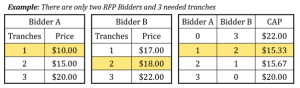 In this example, the winning combination is when Bidder A supplies 1 tranche and Bidder B supplies 2 tranches, and the CAP is $15.33. Even though Bidder A’s bid for two tranches is $15.00, lower than the CAP $15.33, it would not be included in the winning combination.
In this example, the winning combination is when Bidder A supplies 1 tranche and Bidder B supplies 2 tranches, and the CAP is $15.33. Even though Bidder A’s bid for two tranches is $15.00, lower than the CAP $15.33, it would not be included in the winning combination.FAQ-11. What are the load caps in the DS solicitation?
There are two load caps in the DS solicitations. There is an 85% solicitation load cap based on tranches in each solicitation. There is also a 50% aggregate load cap based on percent of default service load of a Customer Group an RFP Bidder can serve at any given point in time. This applies to both Residential and Small C&I. The limit on tranches bid in any given solicitation will take into account percentage of load associated with tranches won under prior Full Requirements RFPs under the same DSP. (The Bidder Information Webcast Presentation PDF has additional details about the load caps.)
The number of load caps will be provided as an attachment to your notification of qualification by the RFP Manager.